
Beautiful yacht interiors may appear effortless when complete, but achieving that result requires hundreds of interconnected decisions made over months, and sometimes years. A full-service yacht interior designer does far more than select furnishings, fabrics, and finishes. As a full service yacht design firm, we guide a project from its earliest conversations through design development, documentation, sourcing, production, installation, and final detailing.
At Destry Darr Designs, that means maintaining the original vision while navigating the realities of yacht construction, refit schedules, marine requirements, budgets, lead times, and life onboard. Every stage informs the next, and every detail ultimately contributes to the whole.

PHILOSOPHY
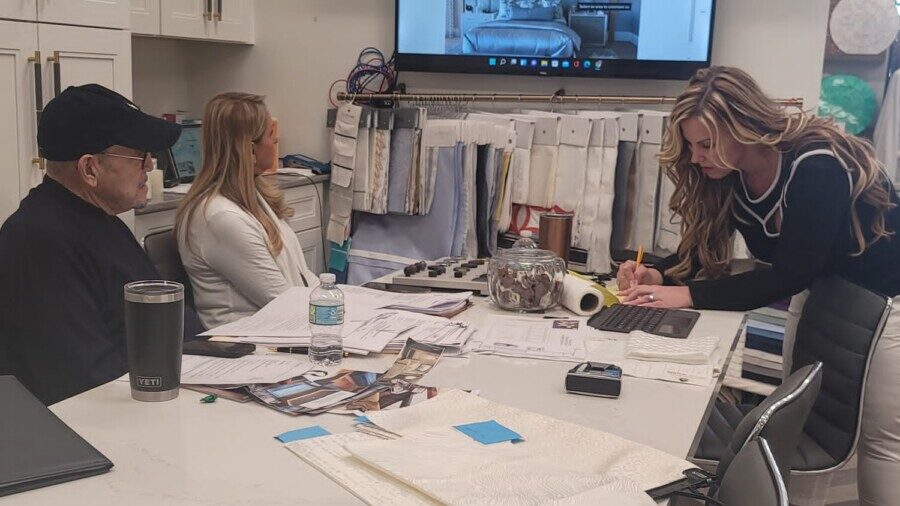
Great yacht interiors aren’t created through a series of isolated choices. They evolve through a carefully managed sequence in which each decision informs the next. Layout affects furniture. Furniture affects lighting. Materials influence fabrication. And every aesthetic choice must ultimately work within the technical realities of the vessel.
As full-service designers, we oversee that sequence from concept and space planning through specifications, sourcing, production, and installation. Our experience with custom builds and complex refits allows us to anticipate decisions before they become problems and maintain continuity as a project moves from paper to production. The objective is simple: protect the design intent, the owner’s investment, and the quality of the finished interior.
DISCOVERY
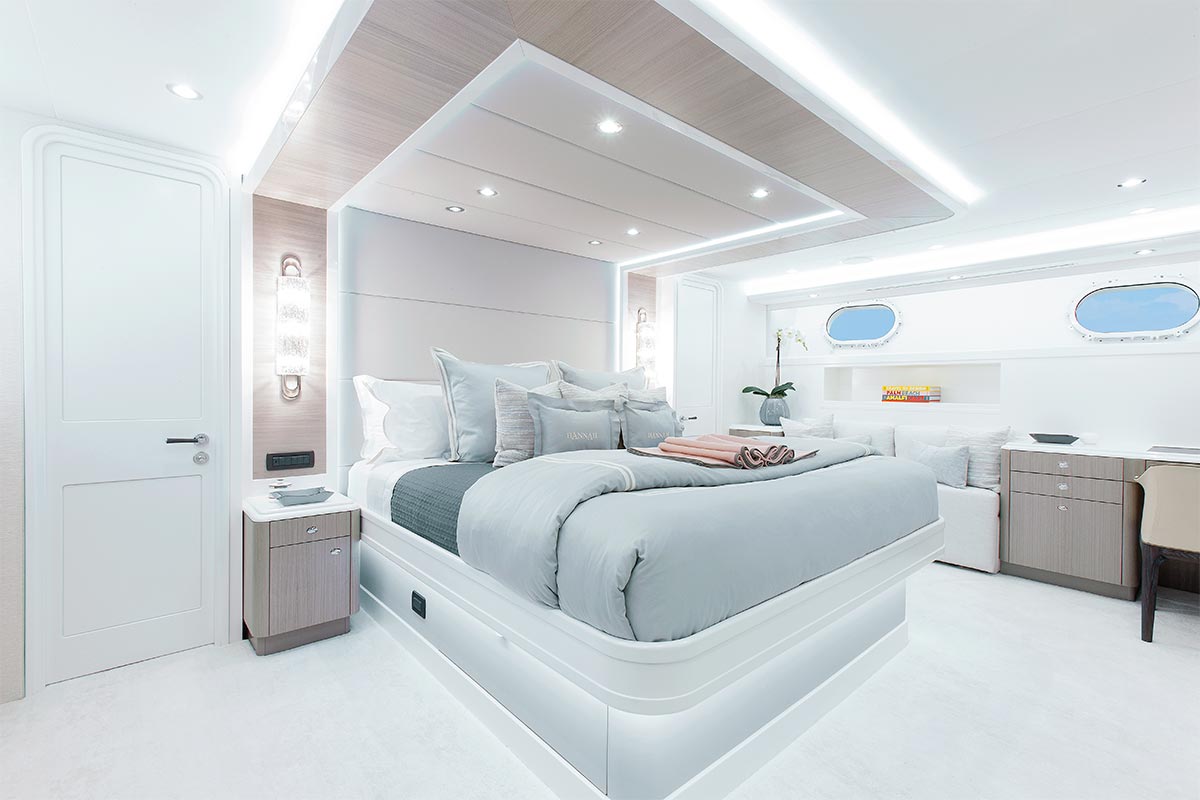
Before we draw a line or select a fabric, we listen. Who will use the yacht? Is she primarily a private family retreat or an active charter vessel? How does the owner entertain? Are children or pets frequently aboard? Where does everyone naturally gather? What has worked well on previous yachts, and what hasn’t?
These conversations establish much more than aesthetic preferences. They reveal how the yacht needs to function day to day. We consider everything from entertaining and dining to storage, circulation, maintenance, and the relationship between guest and crew spaces. Understanding those priorities at the beginning gives us a framework against which every subsequent design decision can be measured.
REFITS
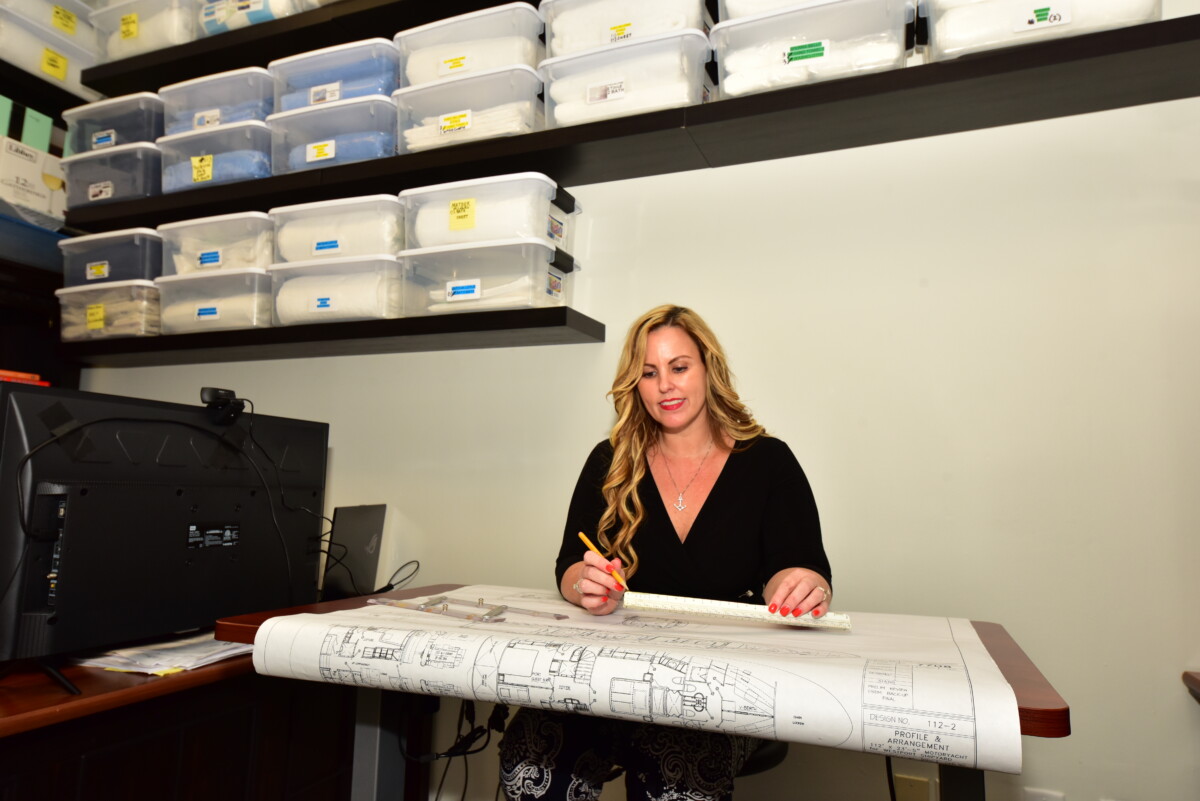
A refit doesn’t begin with a blank page. It begins with understanding what is already there.
We walk the yacht carefully, assessing the existing layout, furnishings, finishes, lighting, millwork, and architectural details. Some elements may be worth preserving or restoring; others may no longer suit the owner’s needs or the way the yacht is being used. Often, there are opportunities hidden within an existing interior that only become apparent once we begin looking closely.
This assessment helps determine where changes will have the greatest impact and where restraint may produce the better result. Good refit design isn’t about replacing everything. It’s about knowing what deserves to remain, what can be improved, and what needs to change.
SPACE PLANNING
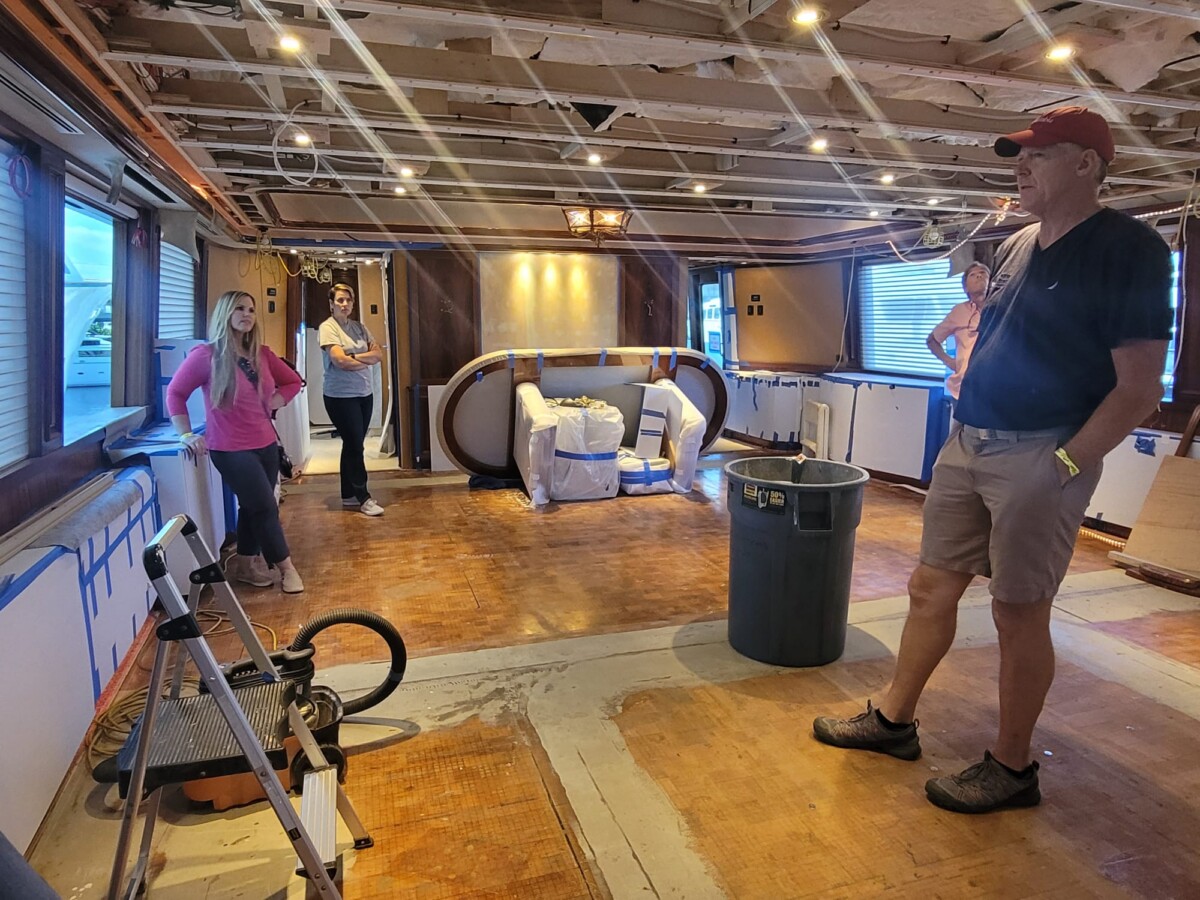
Before an interior can be beautiful, it has to work.
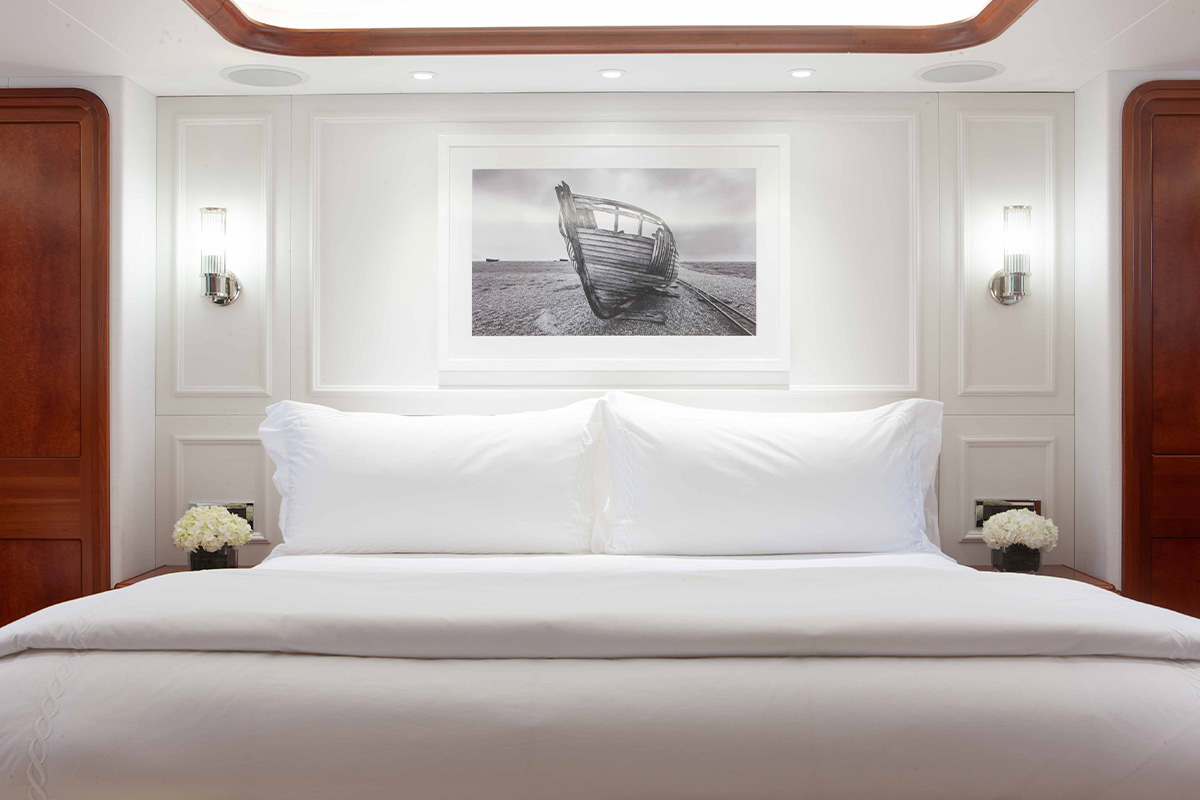
We study circulation, furniture placement, sightlines, proportions, storage, and the relationship between spaces. On a yacht, where every inch matters, even a seemingly minor adjustment can dramatically improve the way a room functions. A dining chair needs enough clearance to move comfortably. A passageway must remain intuitive. Furniture must feel properly scaled without compromising circulation.
This is also where experience aboard yachts becomes invaluable. A layout may appear successful on a drawing but behave very differently when guests, crew, luggage, service, and movement are introduced. We resolve those considerations early, creating the foundation upon which the rest of the interior can be built.
CONCEPT DIRECTION
Once we understand the yacht and the owner’s priorities, we begin defining the visual direction.
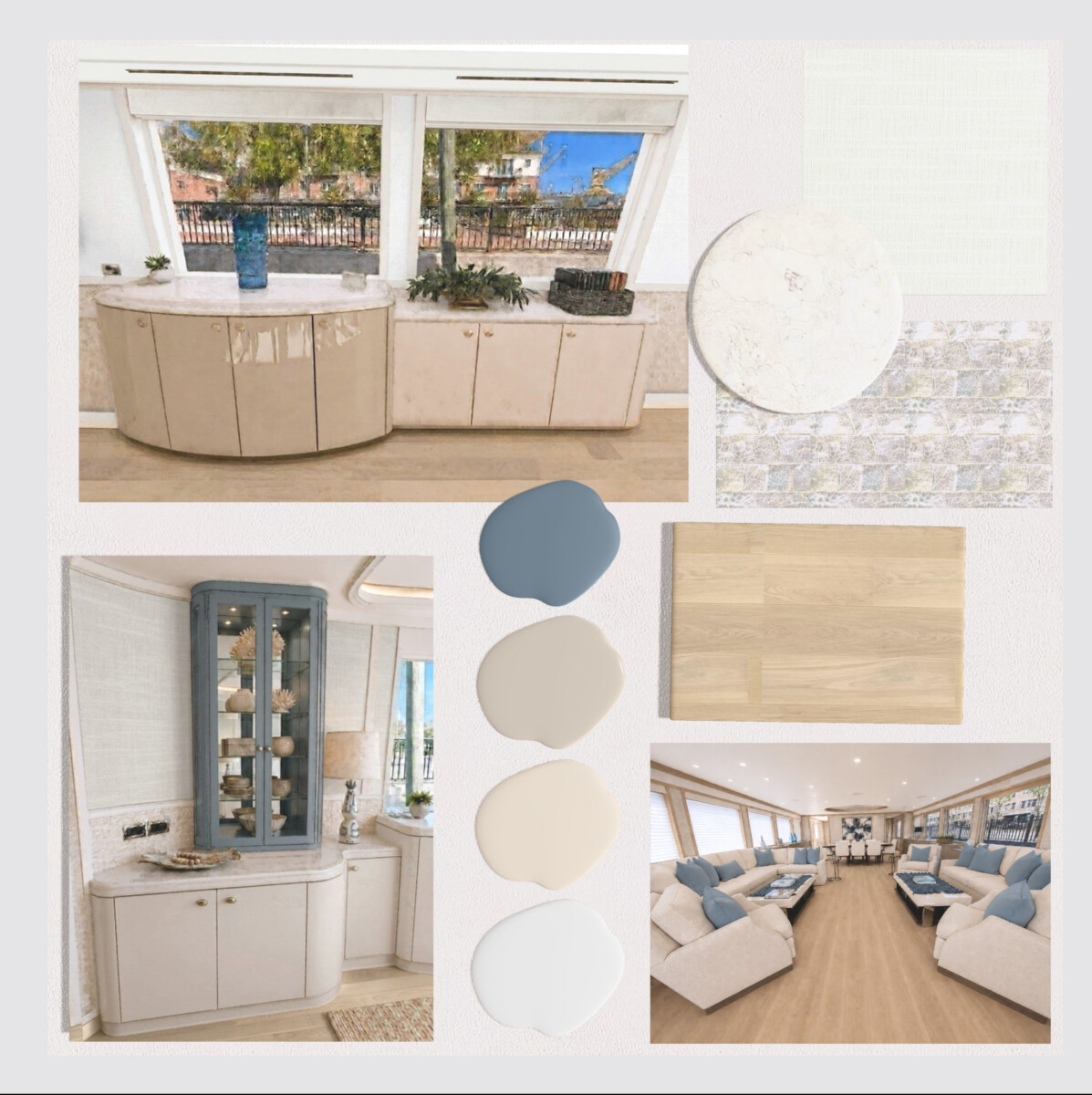
Concept development establishes the mood, palette, materials, forms, and overall character of the interior before individual selections begin to take over. Inspiration imagery, preliminary materials, furnishings, and color studies allow us to communicate how the finished yacht should feel and give the owner an opportunity to respond to the direction as a whole.
This isn’t about following a particular trend or prescribing a signature “look.” Each project should reflect its owner, architecture, and intended use. Establishing that design language early creates a reference point for the hundreds of decisions that follow and keeps the project visually cohesive as it develops.
MATERIALS SELECTION
Material selection aboard a yacht requires a different mindset than residential design. A beautiful fabric, stone, wood, wallcovering, or finish also has to contend with humidity, salt air, UV exposure, movement, cleaning, and the realities of marine use.
We evaluate materials for both appearance and performance, considering how they will age and how the yacht will be used. A private yacht may accommodate certain delicate finishes that would be impractical aboard a busy charter vessel. Weight, maintenance, durability, and marine requirements can also influence a specification.
The goal isn’t simply to find beautiful materials. It’s to create a layered, sophisticated palette in which every selection earns its place and continues to perform long after the yacht leaves the yard.
KEY ELEMENTS
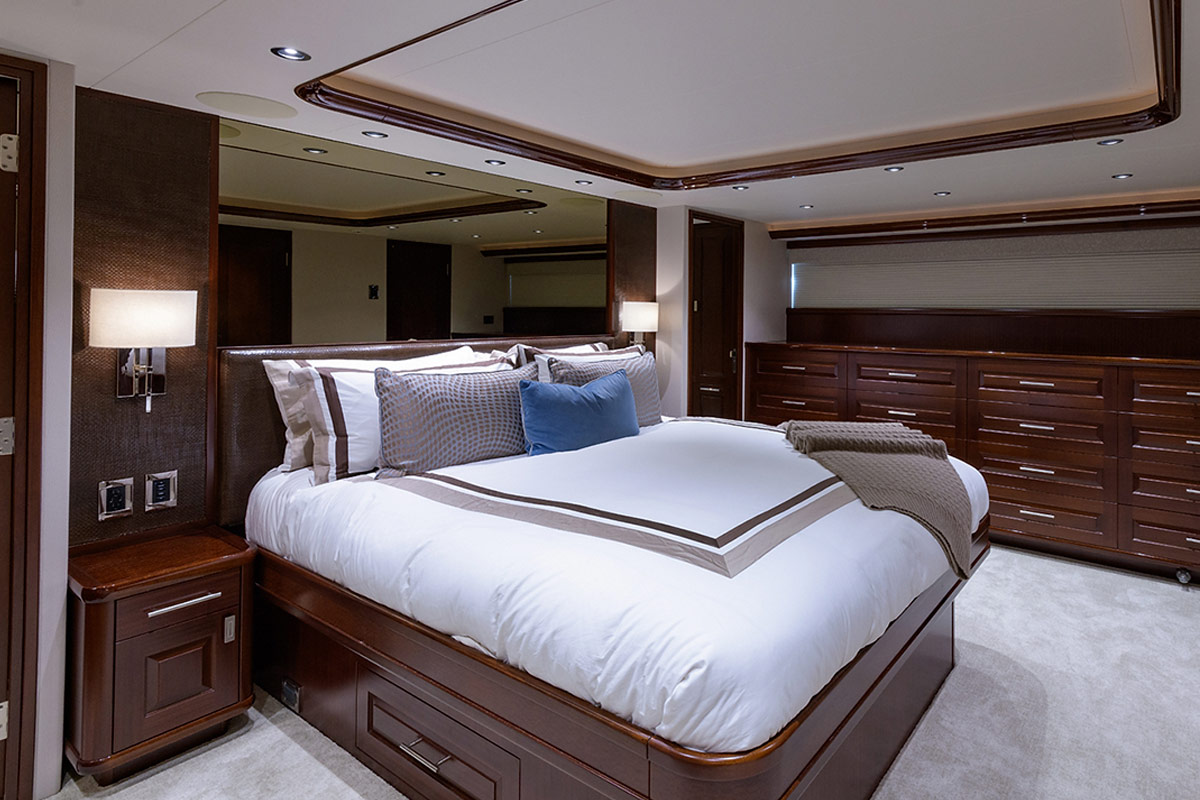
With the broader design established, we begin developing the elements that give each space its individual character. Lighting, furniture, decorative hardware, stone, rugs, artwork, and custom pieces are considered together rather than as independent additions.
This is often where an interior begins to feel personal. A custom dining table might become the focal point of a salon. A particular stone may inform surrounding finishes. Lighting can completely change the atmosphere of a space once the sun goes down.
At the same time, creativity must remain grounded in what can actually be fabricated, sourced, delivered, and installed. We work with vendors and craftspeople throughout this process so that signature design moments are not simply beautiful ideas, but achievable ones.
VISUALIZATION
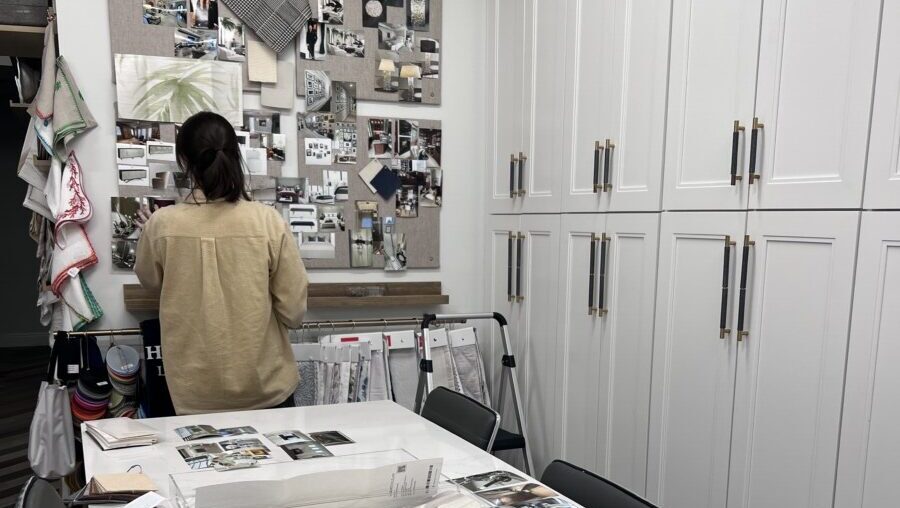
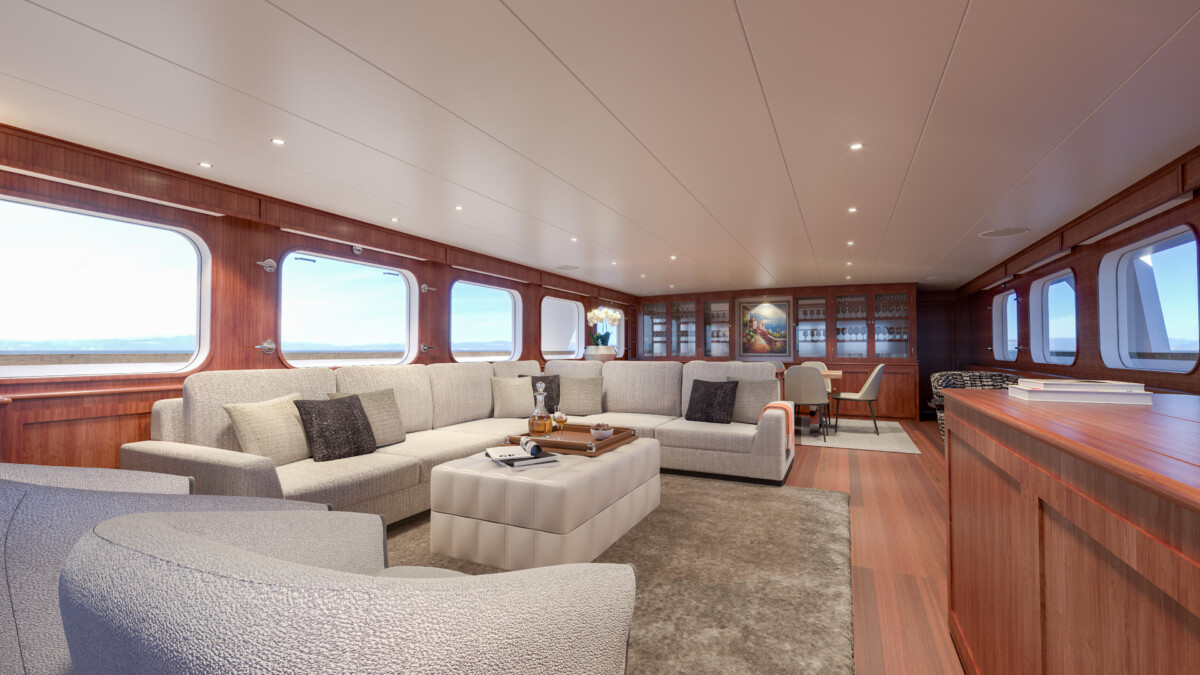
Renderings transform plans, samples, and individual selections into something the owner can experience as a complete space.
By this stage, the major design decisions have already been carefully developed. Visualization allows us to bring those elements together, studying proportions, color relationships, furniture placement, lighting, and architectural details in context. It also gives owners an opportunity to understand how choices that may have been viewed individually will interact once installed.
This can be an important moment in the process. What began as conversations, drawings, and material samples suddenly becomes recognizable as the future interior. Renderings also provide a valuable reference as the project advances, helping the design team, shipyard, contractors, and fabricators remain aligned around the intended result.
TECHNICAL DRAWINGS
A beautiful concept only succeeds if it can be executed accurately.
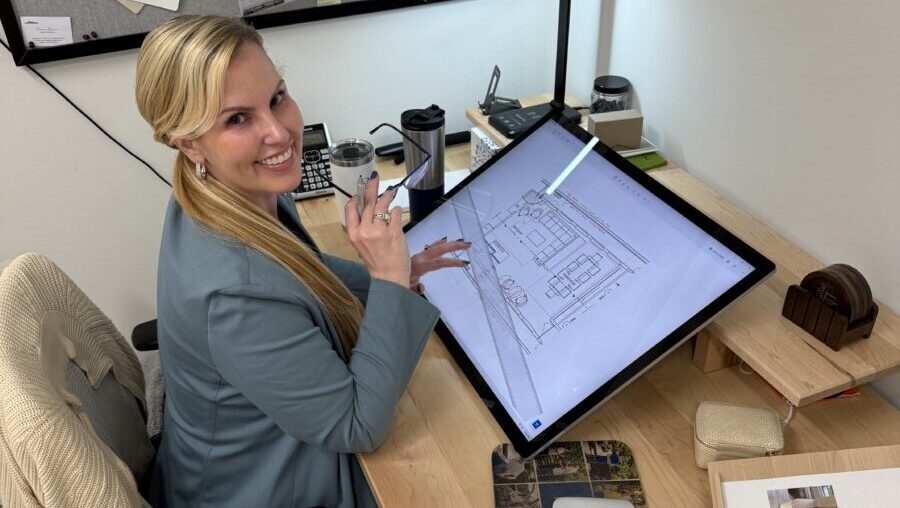
Once the design direction is approved, ideas are translated into detailed drawings that communicate dimensions, materials, construction details, furniture placement, millwork, lighting, and other critical information to the people responsible for building the interior.
This documentation removes ambiguity between design intent and fabrication. It allows shipyards, contractors, cabinetmakers, stone fabricators, upholsterers, and other specialists to understand not only what something should look like, but how it should come together.
Technical drawings are also an important coordination tool. By resolving details before fabrication begins, we can identify potential conflicts earlier, answer questions before they reach the workshop, and give craftsmen the information they need to execute the design properly.
SPECIFICATIONS
As the design develops, every approved selection needs to be documented.
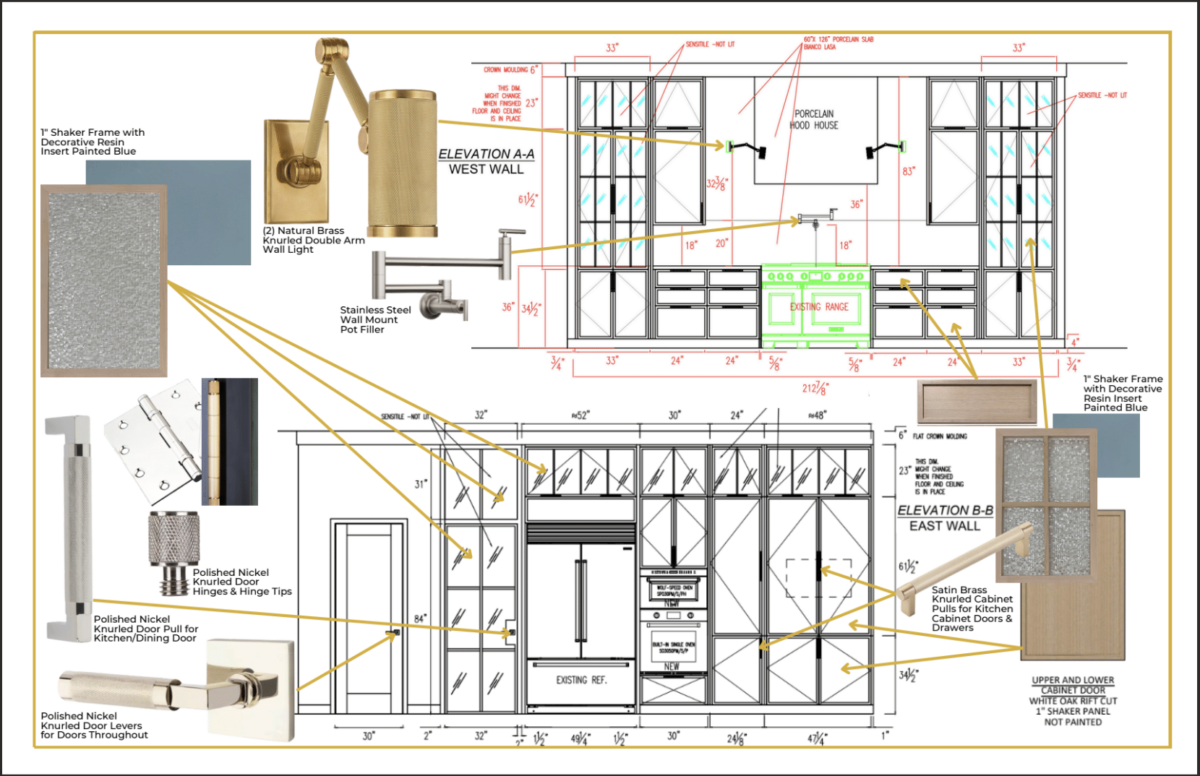
Specifications create the detailed roadmap for the interior, identifying materials, finishes, fabrics, wallcoverings, hardware, fixtures, furnishings, and other components and connecting them back to the approved design. This becomes especially important on a yacht project, where numerous vendors, contractors, shipyard teams, and craftspeople may be working simultaneously.
Precise documentation helps ensure that the fabric approved for a particular chair is the fabric that reaches the upholsterer, the correct finish is applied to the millwork, and the intended hardware is installed in the right location.
The glamorous part may be selecting beautiful things. The less visible work of documenting them correctly is what helps ensure the finished yacht actually reflects those selections.
SOURCING & PROCUREMENT
Knowing what belongs in a yacht interior is only half the equation. You also need to know who can make it, where to find it, how long it will take, and whether it can meet the project’s requirements.
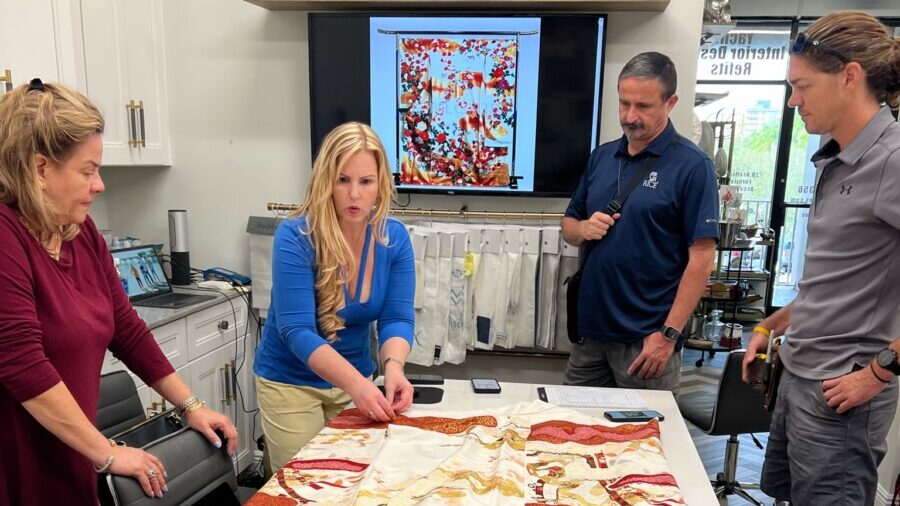
Years in the yachting industry have allowed us to build relationships with trusted craftspeople, workrooms, mills, fabricators, showrooms, manufacturers, and vendors who understand the standards expected aboard a yacht. Those relationships are particularly valuable when a project calls for something custom or technically challenging.
Our procurement process carries selections from approval through ordering and delivery, with attention to pricing, quantities, lead times, and scheduling. The goal is to make sourcing part of the larger design process rather than a disconnected exercise in purchasing.

SAMPLES & MOCK UP
An approved material is only the beginning. Before committing to production, we often need to see how that material will actually be executed.
Samples and mock-ups allow us to evaluate color, sheen, texture, stitching, scale, joinery, finish quality, and the way different materials meet one another. A wood stain can look entirely different across species. A fabric behaves differently once upholstered. A metal finish may shift depending on lighting and adjacent materials.
This stage creates an opportunity to refine those details before they are multiplied throughout the yacht. If something needs adjusting, this is the moment to do it. Taking the time to review workmanship before production helps prevent expensive corrections later and gives everyone a clear benchmark for the expected finish.
INSTALLATION
Installation is where years of decisions finally converge.
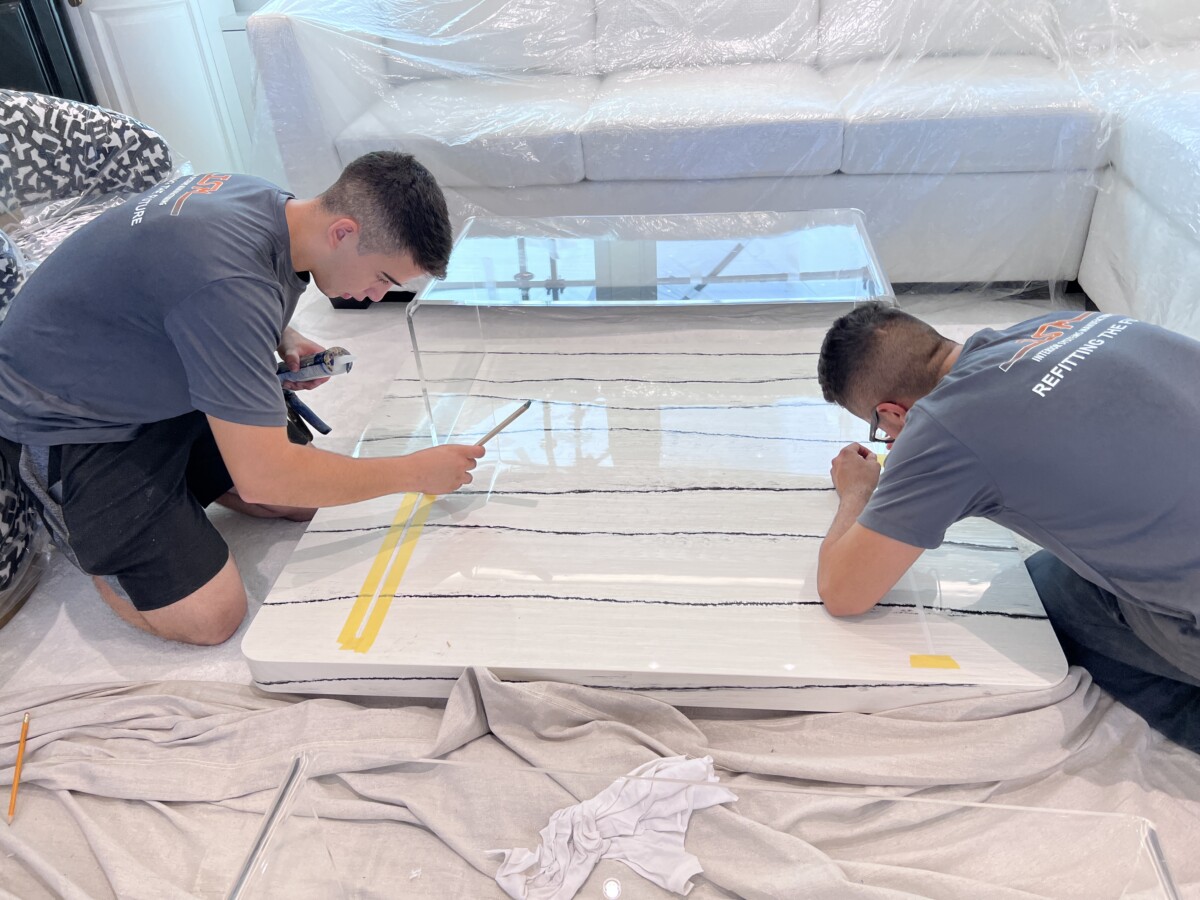
Final measurements are confirmed onboard, custom pieces move into production, orders arrive, freight is coordinated, and numerous vendors and installers must work within the yacht’s schedule and often within very tight physical spaces. Timing matters because one delayed element can affect several trades that follow.
Our involvement continues throughout this phase. We coordinate deliveries and installation, review work onboard, address questions as they arise, and ensure that individual pieces relate to the design as intended.
Then come the final layers: furniture placement, artwork, accessories, bedding, and the small adjustments that make the yacht feel complete. The transformation can appear sudden. In reality, it is the culmination of every carefully managed step that came before it.
LET’S GET STARTED!
Every yacht project begins differently. Some owners come to us with a new yacht and a clear vision. Others know only that their current interior no longer reflects how they live. A captain or project manager may bring us into a refit before the full scope has even been determined.
The first step is simply a conversation.
We’ll discuss the yacht, the project, how you intend to use her, what you hope to accomplish, and where you are in the process. From there, we can determine the appropriate scope and begin building a design process around your particular needs.
From the first idea through the final installation, our role is to make an inherently complex process feel considered, coordinated, and cohesive.
Contact Destry at destry@destrydarrdesigns.com to schedule a consultation today!